DOWNLOAD THE ENTIRE AUGUST 2015 NEWSLETTER including this month’s freebie.
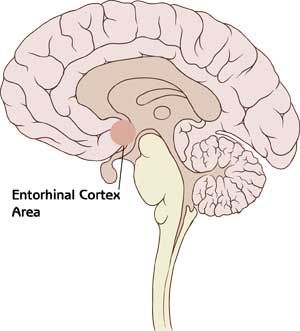
After wandering round a unfamiliar part of town, can you sense which direction to travel back to get to your car or the station? If so, you can thank your entorhinal cortex, a brain area recently identified as being responsible for our sense of direction. Variation in the signal in this area might even explain why some people are better navigators than others.
The new work adds to a growing understanding of how our brains knows where we are. Groundbreaking discoveries in this field won last year’s Nobel Prize in Physiology or Medicine for John O’Keefe, a neuroscientist at University College in London, who discovered ‘place cells’ in the hippocampus, a brain region most associated with memory. These cells activate when we move into a specific location so that groups of them form a map of the environment.
O’Keefe shared the prize with his former students Edvard Moser and May-Britt Moser, both now at the Kavli Institute for Systems Neuroscience in Norway, who discovered ‘grid cells’ in the entorhinal cortex, a region adjacent to the hippocampus. Grid cells have been called the brain’s GPS system. They are thought to tell us where we are relative to where we started.
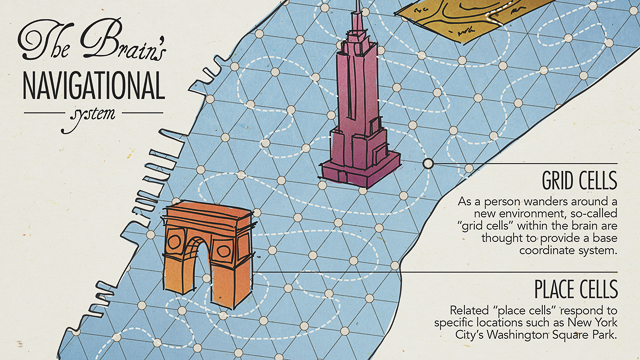
A third type – head-direction cells, also found in the entorhinal region – fires when we face a certain direction. Together these specialised neurons appear to enable navigation, but precisely how is still unclear. For instance, in addition to knowing which direction we are facing, we need to know which direction to travel. Little was known about ho or where such a goal-direction signal might me generated in the brain until the new study.
A team of researchers asked 16 volunteers to familiarise themselves with a virtual environment consisting of a square courtyard with a landscape (such as forest or a mountain) on each wall and a unique object in each corner. They then scanned the participants’ brains while showing them views from the environment and asking them to indicate in which direction different objects lay.
The entorhinal region displayed a distinct pattern of activity when volunteers faced each direction – consistent with how head-direction cells should behave. The researchers discovered, however, that the same pattern appeared whether the volunteers were facing a specific direction or just thinking about it. The finding suggests that the same mechanism that signals head direction also simulates goal direction. How, exactly, the brain switches back and forth is unclear, but the researchers think the brain probably signal which direction you are facing until you consciously decide to think about where you want to go, at which point the same cells then run the simulation.
 Interestingly, the more consistently the participants’ goal-direction signals were, the better they were able to correctly recall in which direction the target objects lay, potentially offering a brain-based explanation for the differences in navigational ability. Such results should be interpreted carefully, however. There are apparently many ways worse performance can lead to weaker effects; for instance, if a participant’s attention lapses, he or she will not only perform worse but also produce less relevant brain activity.
This work may have clinical relevance. The ability to navigate is often an early casualty of dementias such as Alzheimer’s disease because the entorhinal region is one of the first areas to be affected. One group of neuroscientists is now working with doctors to develop tests to help identify deficits and potentially measure disease progression.