
DOWNLOAD THE ENTIRE OCTOBER 2018 NEWSLETTER including Freebie
Before you think I’ve gone completely crazy, let me explain….Research suggests meaningful work can be something you grow into, not necessarily something you discover
On the surface, goals around fulfilment and purpose seem great. Instead of seeking power, status or personal wealth, many are motivated to discover their interests and uncover the path that excites and drives them. They want a career that lights their fire. “Do what you love and you’ll never work a day in your life” or “Do what you love and the money will follow.” Right?

However, recent research by investigators at Yale and Stanford suggests that ‘finding your passion’ as an approach might be a mistake. Rather than seek the one job or career path that ignites our passion, we should try different interests and work to then cultivate a passion in one or more fields. By this view, interests are nurtured over time, but not discovered overnight.
The key clue here is mindset.
Some people adopt a “fixed mindset” approach and search for the one, predestined match in their lives. They expect this match to be enduring, full of excitement, and endlessly fulfilling. Fixed mindsets have been observed with romantic relationships and intelligence. Individuals with “destiny” mindsets about romantic relationships often seek “the one,” and tend to move on when faced with relationship challenges. Individuals with fixed mindsets of intelligence believe that intelligence derives from a fixed talent and cannot be cultivated or nurtured through experience. Across all these domains, fixed mindsets tend to dismiss the idea that exploration and resilience can lead to positive change.
A fixed mindset about interests can be limiting in two ways.
First, it implies that our interests and talents may be narrow or specific. Once we find a path that intrigues us and brings success, we may curb or even abandon exploration of other potential interests.
Second, we may expect pursuit of our one true passion to be easy – after all, this is the pathway that will provide endless drive and excitement, and will yield the greatest achievement. Consequently, instead of demonstrating resilience and perseverance in pursuit of this passion, we may collapse when faced with failure or significant challenge. Difficulty may be perceived as indication that we are simply on the wrong path.
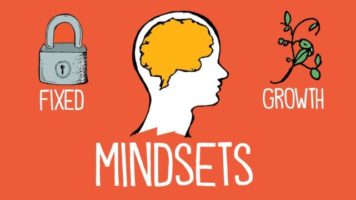
By contrast, individuals with a “growth mindset” believe that interests or passions can be developed or cultivated through experience, investment, and struggle. There is not a single, “right” path to be discovered or revealed; instead, many different interests are possible, even simultaneously. With a growth mindset, success in one arena doesn’t exclude or limit exploration of other interests, nor does difficulty signal the need to change course.
Evidence from five experiments demonstrates that mindsets significantly influence what we expect to happen when pursuing our interests and how we respond to new possibilities and challenges.
In one study, researchers first determined whether participants had a fixed or growth mindset about interests using a simple questionnaire. This survey gauged the extent to which individuals perceived interests to be permanent, steadfast, and static (fixed mindset), or malleable, flexible, and dynamic (growth mindset). Participants then gave answers to several open-ended questions concerning their expectations about outcomes when pursuing a passionate interest. Relative to participants who expressed a growth mindset about interests, those who expressed a fixed mindset were far more likely to expect endless motivation and minimal struggle when pursuing a confirmed passion.
Additional studies demonstrated that mindset influences more than expectations; mindset changes behaviour. In one paradigm, participants read two different articles, one that matched their personal goals and pursuits, and one that did not. Participants rated their interest in each article. When the article content matched participants’ pursuits, having a fixed versus growth mindset did not matter; everyone found the matching article interesting. When the article content mismatched participants’ pursuits, those with a fixed mindset reported far less interest in the material than those with a growth mindset. In other words, a fixed mindset diminished curiosity about topics not directly relevant to one’s primary pursuit.
Mindset also affected outcomes in the face of difficulty. In a final study, participants first watched a popular science film clip about black holes, and rated their interest in the clip. Most found it fascinating. Those expressing high interest in black holes after viewing the film then read a complex technical report on black holes. They rated both how difficult and how interesting they found the report. Among those who found the technical report difficult to read, those with a fixed mindset subsequently expressed far less interest in black holes than those with a growth mindset. These findings suggest that when individuals with a fixed mindset pursue an emerging interest, they are more likely to lose interest in that topic if it becomes challenging.
 On the bright side, a fixed mindset about interests may have its benefits. It may foster a single-mindedness that reduces distraction and promotes completion of a task. Assuming an individual faces minimal frustration when pursuing a passion, a fixed mindset may promote contentment and prevent endless consideration of alternative interests.
A fixed mindset about interests is likely to be a hazard, however, when advances within one’s field require the integration of broad and diverse knowledge sets, or when resilience is needed in facing new hurdles. For these reasons, if you have no idea what you want to do in life, try out a variety of courses, workshops, open days to seek an range of experience. And include things that stretch you beyond your comfort zone. Rather than searching for your one true passion, remember that interests, expertise, and even passion can be cultivated through experience, persistence……and maybe a bit of hard work too.
References:
Paul A. O’Keefe, Carol S. Dweck, Gregory M. Walton. Implicit Theories of Interest: Finding Your Passion or Developing It? Sage Journals, Psychological Science, 6th September 2018. https://doi.org/10.1177/0956797618780643
Raymond Knee and Kristen N. Petty. Implicit Theories of Relationships: Destiny and Growth Beliefs in The Oxford Handbook of Close Relationships
Edited by Jeffry Simpson and Lorne Campbell, April 2013.
Carol S. Dweck. Essays in social psychology. Self-theories: Their role in motivation, personality, and development. New York. Psychology Press 1999.