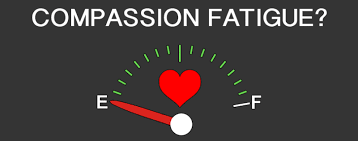
As a therapist, I’m especially concerned about one specific type of burnout that I see increasingly happening to those in the caring and healing professions — compassion fatigue.
This can happen when you have experienced so much empathy for and absorbed so much of others’ suffering that you yourself begin to have trauma reactions. This seems (to me) to be getting more prevalent as a result of all the Corona problems. Those reactions can include things like emotional numbing, physical illness, and feelings of hopelessness.Ironically, one of the very traits that make a person good at being a nurse or therapist or just a good friend can become a liability.
 Compassion fatigue was first described in emergency department nurses and oncology nurses. Nurses may constantly witness pain, decline, and death, often without being able to save patients no matter how much of themselves they put into their work. Compassion fatigue has also been documented in child protection workers and mental healthcare providers.
Compassion fatigue can even happen to people who don’t work in the helping professions. People who are highly empathic almost can’t help but feel others’ pain.
How can we protect ourselves from compassion fatigue while continuing to care for others? The answer is not to become emotionally numb to others’ suffering, but rather, to build good boundaries, take care of ourselves, and better understand our role.
Let’s have a look at how to protect yourself from compassion fatigue.
- Know the signs of compassion fatigue
Fatigue—just being tired all the time—is one of the most common things people experiencing compassion fatigue report. That makes sense because pumping stress-related hormones, and often having the fight-or-flight system on high alert, uses up a lot of energy.
Some other signs of compassion fatigue include:
- Trouble sleeping (can’t shut off thoughts, feeling too wound up, easily woken)
- Irritability, impatience, anger, blaming others
- Dreading going to work (or finding yourself often late for work or calling in sick)
- Having a hard time empathising or finding meaning in your life or work
- Having unexplained physical symptoms (such as exacerbated pain, acne flare-ups, gastro-intestinal problems)
- Feeling isolated or wanting to isolate from others
- Feeling helpless, hopeless, or both
- Having trouble making decisions
 Having just one or two of these symptoms could be a fluke. But if you’re experiencing a few of these, chances are good that you’re experiencing compassion fatigue.
The first thing to do is to recognise that compassion fatigue is not a weakness. It also doesn’t mean you’re not compassionate anymore. It’s very natural for your body and mind to react this way. But now that you’re aware of what’s happening, it’s not too late to start doing something to help improve – or avoid – it.
- Hit the reset button and take care of your basic needs
Sometimes we underestimate the importance of the basics—water, food, sunlight, oxygen. And sometimes, we get so overwhelmed with our thoughts and emotions that we neglect these basics. It can almost feel silly to say it, but a powerful reset button for your body and mind can simply be one weekend of:
- Carrying a water bottle everywhere and constantly sipping
- Eating balanced meals and snacks at consistent times (rhythms are important!)
- Spending at least 30 minutes per day outside in the sun. (Bonus points if you’re physically active or spending time with friends!)
- Beware of destructive coping methods
When we feel emotionally depleted, it can be tempting to reach for quick fixes and shortcuts. This might mean reaching for that third or fourth glass of wine because it feels relaxing in the moment, or compulsively online shopping beyond our budget because we find comfort in “retail therapy,” or saying hurtful things to people we love because it feels like that’s the only way to express our anger. We’ll try anything that gives us a chance to release some tension. The problem is that this release is only a distraction. It won’t tap into what’s really weighing you down.
There’s no need to judge yourself for these impulses; they’re just your brain trying to help you cope with difficult feelings as quickly as possible. But once you’ve noticed what’s going on, be honest with yourself. Take a deep breath and say out loud, “This is not the coping method that will really help me.” Pour the rest of the wine down the drain and move on to the next step.
- Practice self-compassion
 You’ve been giving compassion to your patients or your family or total strangers. But have you been giving any to yourself? Do you forgive yourself for mistakes or cut yourself some slack when you need a break? Do you say to yourself the comforting things that you would say to your best friend? Self-compassion is an important ingredient in loosening up compassion fatigue.
If you haven’t taken care of yourself as well as you have others, it’s not too late. Start by simply sitting quietly with your eyes closed and asking yourself, “What do you feel? How do you feel?” There’s no rush to arrive at an answer—don’t automatically tell yourself that you’re “fine.” Sincerely take the time to walk your attention through your body and ask each body part what it feels. At some point, you’ll arrive at emotions that might have been hiding in your stomach or scrunching up your jaw. When you get there, allow yourself to feel whatever emotions you find, whether pleasant or painful.
Say to yourself, out loud:
- It’s okay to feel like this.
- I’ve been carrying a lot, so it’s natural to feel heavy.
- I’ve been so strong, and I need some relief.
- Practice radical acceptance
As a caregiver, or even just an emotionally sensitive person, you might be holding onto ideas like:
- “I need to take care of people.”
- “If I don’t care of them, nobody else will.”
- “If only I worked harder, maybe I could have saved them.”
This sense of responsibility we feel for righting wrongs and healing hurts is a double-edged sword. On one hand, it’s the fuel that drives us to be compassionate—to be a therapist, doctor, nurse, or just a very caring person in general. On the other hand, it can give us a disproportionate sense of responsibility, to the point where we think we can, and therefore should, make everything right. The reality is that there are many, many things we can’t control no matter how much we care. Even the best treatment cannot always save a patient, the wisest advice cannot always change someone’s mind. 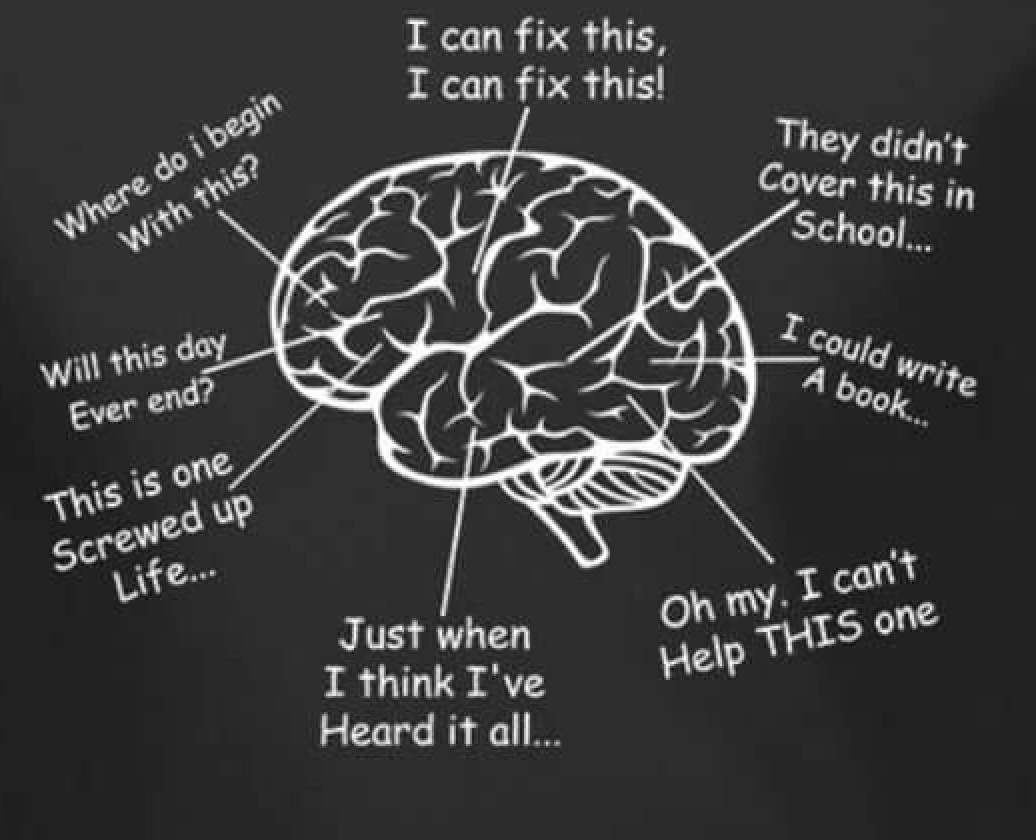
In moments when we catch ourselves thinking, “If only…” (“If only he would take better care of himself,” “If only the system weren’t so stacked against her,” “If only this child had grown up in a safe home”), we need to practice radical acceptance.
Radical acceptance means recognising that you cannot ultimately control anyone or anything; you can only control your own actions. It challenges you to allow that there will always be pain, injustice, uncertainty, and imperfection in the world. When you put down the weight of perfection and responsibility, you can breathe and be a force for good in a sustainable way.
- Compartmentalise
There’s a reason we have different rooms in a house for different activities. We humans need contextual cues to help us switch gears between working, playing, relaxing, and all of our important modes of being. We can harness this to redirect from compassion fatigue to balanced living.
In practice, this means that if your job is causing you compassion fatigue, you keep work at work. When you come home, consciously tell yourself, “I’m leaving my patients/clients at work” before walking into your home. Change out of your work clothes right away and immediately do something that takes up your attention (not a mindless chore), ideally something fun.
You may have to get creative to design your own compartmentalisation. If your compassion fatigue is coming from work, some good elements you might include are:
- Maintaining a social life (in as far as that is possible nder the current COVID restrictions) with people other than your coworkers
- Consistently doing hobbies and activities that have nothing to do with work
- Having a ritual to mentally set aside work when you leave, such as having a box on your desk that you symbolically put all work-related thoughts and emotions into
- If you work from home, making sure that you have a separate room for work and leisure
- Get support from friends (or a therapist)
Social support is as close to a psychological panacea as it gets. This may be especially true for compassion fatigue, a condition that can make us feel lonely and isolated even when we’re surrounded by people.
If you work in a helping profession, you may have access to support groups (inclusing intervision/supervision groups) at work specifically designed to give you a safe space to vent. You’ll be surrounded by others who experience similar emotional rollercoasters, emotional numbing, confusing changes in the way they think about people, or dips in their ability to find meaning in their work. Sometimes, just having these feelings validated can go a long way toward rejuvenating you. Better yet, join a mindfulness class. These have successfully decrease compassion fatigue and increased compassion satisfaction for helping professionals.
If you don’t have support groups, share your feelings with a trusted friend or coworker, someone who will not be judgmental. A therapist, too, can help you to process what you’re going through.
We all deserve to have an empathic ear when we’ve been lending ours, and to be carried when we’ve been carrying others.
REFERENCES:
Stacie Hunsaker et al. Factors That Influence the Development of Compassion Fatigue, Burnout, and Compassion Satisfaction in Emergency Department Nurses. Journal of Nursing Scholarship. 2015. Volume 47, Issue 2, pages 186-194.
David Conrad and Yvonne Kellar-Guenther. Compassion fatigue, burnout, and compassion satisfaction among Colorado child protection workers. Child Abuse & Neglect. Volume 30, Issue 10, October 2006, Pages 1071-1080.
Charles R. Figley. Compassion fatigue: Psychotherapists’ chronic lack of self-care. Journal of Clinical Psychology. Volume 58, Issue 11, November 2002,Pages 1433-1441.
Patricia Potter et al. Compassion Fatigue and Burnout: Prevalence Among Oncology Nurses. Clinical Journal of Oncology Nursing. October 2010, 14(5), E56-62.
Martin C. Delaney. Caring for the caregivers: Evaluation of the effect of an eight-week pilot mindful self-compassion (MSC) training program on nurses’ compassion fatigue and resilience. PLOS One. November 21, 2018.https://doi.org/10.1371/journal.pone.0207261
Joana Duarte and José Pinto-Gouveia. Effectiveness of a mindfulness-based intervention on oncology nurses’ burnout and compassion fatigue symptoms: A non-randomized study. International Journal of Nursing Studies. Volume 64, December 2016, Pages 98-107.