
Studies show that people remember names better than faces, yet we’ve all experienced times when that’s simply not the case. Hopefully the tips here will help you better recall names, strengthen relationships, and avoid embarrassing moments.
It all starts with channelling your attention when you’re first introduced.
I’ve a friend (let’s call her Ellen) who moved house with her husband almost three years ago. One of the first people she met was a teacher who lived six doors away. Each time she saw my friend walking her two dogs, she’d wave  and say, “Hello Ellen.” Ellen would smile, wave back, and say, “How are you?” or “How’s life?” After engaging in this almost daily ritual for so long, Ellen is too embarrassed to tell her friendly neighbour that she actually doesn’t know what she’s called…she can’t remember her name. Major embarrassement – going on for almost three years now.
I seem to have been blessed with being able to remember names and faces. I wouldn’t go as far as to say that I’m a ‘super-recogniser’ – someone with exceptional face recognition abilities – but I do okay. As long as it’s ‘live’, as I’ve recently discovered. So I set out to discover how I do what I do naturally – and now apply it to those pesky online workshops.
You Know the Face, Why Not the Name?
There are studies that suggest we’re better at remembering names than faces. For some people that’s not true though – they’ll recognise a face, but not their name. It turns out that one of the reasons this happens is that you don’t give your brain a chance to process the information.
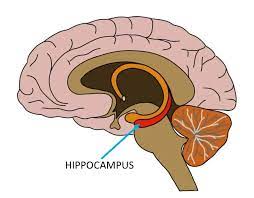 The hippocampus is key to our ability to take two things that are not associated in our minds and put them together. When you meet someone whose name and face aren’t previously associated in your mind, your hippocampus plays an important role in putting these things together into a single memory. That gives you the ability to know how to address the person.
The good news: Familiar names no longer depend on your hippocampus.
Identify Why It’s So Difficult to Retrieve Names
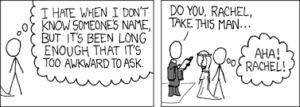
 When you meet someone, you may be focused on impressing the person with your skill and expertise rather than learning more about them. You introduce yourselves and shake hands (or fist bump in the current Corona climate). But when you pass the person again at the event, why do you draw a blank?
According to Kevin Horsley, a grand master of memory and author of Unlimited Memory, one of the biggest problems is that people don’t actually hear the name. They’re not really concentrating because they’re trying to be interesting instead of trying to be interested.
The bottom line: Conjuring up a name is difficult when you haven’t taken the time to listen to it.
Go From Listening to Learning
When you study a new subject in school or prepare for a presentation at work, it takes time to learn the material. It’s unreasonable to assume you can learn the information once and be able to recall facts within minutes. Instead, you study and review the subject matter before a test or a meeting with a client. The same applies to meeting someone once and expecting their name to flash in your mind. This is often described as the “tip-of-the-tongue” phenomenon. You can’t remember the name because you never learned it properly. But….there are a few ways to improve your recall ability.
Focus on Retrieval
It’s easier to retrieve something you’ve pulled from your mind a short time before. One tip that the nueroscience research suggests is to go back to someone shortly after your first encounter. For example, while at a party, you could say, “Hello Jill,” and then two minutes later say, “I’m sorry, what did you say, Jill?” Sneaking in a bit of quick practice through repetition. This process is a predictor of whether or not you’ll know the name later. So even recalling the name once, whenever you can, goes a long way to helping you solidify it in your mind.
Search for Something Unique/Focus of Facial Features
Let’s say you meet a co-worker with a common name you’re confident you won’t forget. But when you pass the person in the corridor a few hours later, you’ve forgotten what they said. The problem may lie in not having made a ‘cognitive effort’. Then because you haven’t created the name in your mind, that’s going to be the one you forget.
 So after you hear someone’s name, repeat it back. You could say, “Nice to meet you, Bill,” then give their name (first or last name) some meaning to help you attach their name and face to each other. Maybe Bill has a nose or mouth that looks like a duck’s bill… (Just don’t call him duck-face to his face….!) Grand Master Kevin Horsley recommends finding significance in a person’s name within a 20-second time frame after hearing it. Doing something creative and connecting that unusual image to the face can serve as a reminder for the next time you get together.
File Names and Notes Electronically in One Place
You could take it a step further – depending on how important it is to you – to make a few notes on someone you just met. It could be using Apple Notes on your iPhone, but Evernote, Google Keep, and Trello all work well. After you meet someone, enter their name, a few facts about the person (their profession, number of children), and where you met. If you do make a list though – remember to look at it often.
Use Social Media as a Reminder
Without moving into the realm of stalking, after you meet someone, you could ask to connect with them on social media.
LinkedIn is frequently used for business contacts, while Facebook and Instagram can provide more personal information. At least then you see the person’s name and profile picture together to help reinforce your memory.
Change the Way You Think
While many conferences and business meetings remain online instead of in person, it’s a good opportunity improve your memory skills. With profile names clearly visible, it should be (should be…) easier to make a connection to a face during an online chat. And you could always make some funny connections to associate distinguishing features to names – and nobody will see. It’ll also help to pass the time if the workshop gets tedious ;=)
More importantly, consider changing your mindset. As with any skill, if you think you’re unable to master it, you may not make an effort to improve. Remember (haha) that there’s no such thing as a good or bad memory for names: there’s only a good or bad memory strategy.
And with that I’m off to look at what other online workshop I can register for that’ll not only be useful for my therapy credits but also to practice my name-to-face memory skills. That’s what I call a win-win, especially when I can make it fun for myself too.
REFERENCES:
Super-recognizers: People with extraordinary face recognition ability
Richard Russell, Brad Duchaine and Ken Nakayama.
Psychon Bull Rev. 2009 Apr; 16(2), pages 252–257.
doi: 10.3758/PBR.16.2.252
I recognise your name but I can’t remember your face: An advantage for names in recognition memory
A Mike Burton, Rob Jenkins, David J Robertson
Q J Exp Psychol (Hove). 2019 Jul; 72(7), pages 1847-1854.
doi: 10.1177/1747021818813081.
Unlimited Memory: How to Use Advanced Learning Strategies to Learn Faster, Remember More and be More Productive
Kevin Horsley. 2016. TCK Publishing.