
Whenever I smell the pages of an old book, I’m immediately time-warped back into my Grandad’s house: encyclopedias, volumes of Readers’ Digest, dictionaries… and thanks to him my enthusiasm to learn and to discover.
And I am not alone! Anecdotally, many of us have had experiences where a certain smell—perhaps chlorine, fresh baked scones, or the salty beach air—floods our brain with memories of a distinct event or location that we associate clearly with certain emotions.
 There’ve also been scientific studies using a variety of approaches to back up this anecdotal evidence. One of the first was a study led by Dr. Rachel Herz at Brown University in 2004. Herz and her collaborators found that a group of five women showed more brain activity when smelling a perfume with which they associated a positive memory than when smelling a control perfume they had never before smelled. The brain activity associated with the memorable perfume was also greater than that produced by the visual cue of seeing the bottle of perfume.
More recently, in another study in 2013, the researchers again found greater brain activity associated with olfactory stimuli (like the smell of a rose) than with visual stimuli (like the sight of a rose). Clinical case studies have also linked smells to strong negative emotions, a connection which can play a significant role in contributing to posttraumatic stress disorder.
So why is this?
The majority of us clearly rely more on a sense of sight than our sense of smell day to day, so what is it about our sense of smell that works to better trigger our memory and our emotions? The link may simply be due to the architectural layout of our brain.
How does our sense of smell work?
 The process through which molecules in the air are converted by our brain into what we interpret as smells and the mechanisms our brain uses to categorise and interpret those odours is, as you have probably guessed, a complicated one. In fact, the process is so complicated that the Nobel Prize in Physiology or Medicine was awarded in 2004 to the researchers Richard Axel and Linda Buck for their work in decoding it.
When we come into contact with an odour, or molecules from volatile substances drifting through the air, the neurons that make up your olfactory receptor cells send a signal to a part of your brain called the olfactory bulb. Axel and Buck found roughly 1,000 genes played a role in coding for different types of olfactory receptors, each of which focus on a small subset of odours. Thus each receptor is not responsible for understanding all possible smells. Those signals are then passed to what are called microregions within the olfactory bulb where again, different microregions specialise in different odours. The olfactory bulb is then responsible for interpreting those signals into what we perceive as smells.
Your olfactory bulb runs from your nose to the base of your brain and has direct connections to your amygdala (the area of the brain responsible for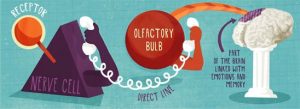 processing emotion) and to your hippocampus (an area linked to memory and cognition). Neuroscientists have suggested that this close physical connection between the regions of the brain linked to memory, emotion, and our sense of smell may explain why our brain learns to associate smells with certain emotional memories.
So many of these odour-driven memories may further be childhood memories because those years are when we experience most smells for the first time.
However….unfortunately…there is not yet research to suggest that we can tap into the link between scents and memory to help us cram for exams or remember where we put our car keys as adults….Not yet ;=)
References
S. Herz et al. Neuroimaging evidence for the emotional potency of odor-evoked memory. Neuropsychologia 2004, volume 42(3), pages 371-8. doi: 10.1016/j.neuropsychologia.2003.08.009.
Arshamian et al. The functional neuroanatomy of odor evoked autobiographical memories cued by odors and words. Neuropsychologia 2013, volume 51(1), pages 123-31. doi: 10.1016/j.neuropsychologia.2012.10.023. Epub 2012 Nov 9.
Vermetten and J. D. Bremner. Olfaction as a traumatic reminder in posttraumatic stress disorder: case reports and review. J Clin Psychiatry 2003, volume 64(2), pages 202-7. doi: 10.4088/jcp.v64n0214.