DOWNLOAD ENTIRE SEPTEMBER 2015 NEWSLETTER including this month’s freebie.
The arrival of a child brings big changes in the brains of the new mothers and fathers. Mothers experience a near immediate shift, thanks in part to the hormones involved in giving birth and nursing. Fathers’ brains tend to change in different and more subtle ways.
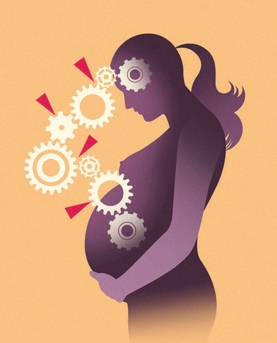
Is ‘Baby Brain’ a Myth?
As many as four out of every five pregnant women say that they suffer from “pregnancy brain”—deficits in memory and cognitive ability that arise during pregnancy, making women more forgetful and slow-witted. Yet studies on the phenomenon have generally not supported these claims: although some have found evidence of problems on certain types of tasks, others, including a recent paper published by researchers in Utah, have found no signs of cognitive problems at all. Some experts believe that pregnancy brain and its postnatal cousin, “baby brain,” could largely be a product of confirmation bias: pregnant women and new mums expect to experience brain fog and therefore believe they are actually affected. Others argue that the mental symptoms might simply be too difficult to confirm in a laboratory setting.
In the most recent study, researchers at Brigham Young University gave cognitive and neuropsychological tests to 21 women in their third trimester of pregnancy and then tested them again six months after they gave birth. They administered the same tests at similar intervals to 21 women who had never been pregnant. They found no differences between the groups no matter when they were tested, including before and after giving birth. These findings mesh with those from a 2003 study, which found that pregnant women did not score differently from nonpregnant women on tests of verbal memory, divided attention and focused attention.
There is variety in the results, but overall most studies suggest there are few to no memory impairments associated with pregnancy. Researchers think the reason the myth persists may be that women selectively look for evidence that supports the cultural expectation. For example, when a pregnant woman loses her car keys, she might blame pregnancy brain—without recalling the times she lost her car keys before she was pregnant.
There is also another possibility, too. In a 2011 study, a team at the University of British Columbia found that although pregnant women did not display any problems on cognitive tests given in a lab, they were less likely than nonpregnant women to remember to call the lab when asked and to return a questionnaire on time. It is possible that lab-based measures do not reveal differences, because labs are typically quiet environments with minimal distractions, in contrast with everyday life.
Motherhood Can Be a Lonely Place
Entering motherhood is a rite of passage for most women. For many new mums, however, the first months and years can be a lonely place. A new study finds that several types of social support are crucial for staving off negative feelings.
Although only 10 to 15 percent of mothers from Western nations will develop a full-blown case of postpartum depression (PPD), many more will experience some serious symptoms of depression. Feelings of PPD are on a continuum, with PPD at the end. Even if PPD can be diagnosed clinically, there is no standard for measuring where the remaining 85 to 90 percent of mothers land on the scale. Researchers estimate that most first-time mothers are overwhelmed.
Becoming a mother is a major transition. New mothers give up autonomy, sleep and relationships to tend to the relentless needs of a baby. On top of that, they are also expected to be in a constant state of bliss and fulfillment with their new role. There can be a lot of pressure to be the perfect mother, and women can be afraid to say they are not coping.
Making matters worse, research that demonstrates the importance of early childhood experiences in determining future success and happiness puts additional pressure on mums to get it right. Also, for working mothers, who are used to a productive mindset and established social routines, it can be difficult to adapt to the repetitive life of meeting the basic daily needs of a baby. Many women appear to go back to work because of the loneliness.
According to a recent study from Patricia Leahy-Warren at University College Cork in Ireland published in the Journal of Clinical Nursing, mothers with strong social support who have confidence in their ability to parent were 75 percent less likely to be depressed than mothers who had neither advantage. There are four parts to social support: hands-on, emotional, informational and appraisal, meaning affirmation that a mother is doing a good job.
Mums require a network of people to meet these four types of social needs. Generally they lean most on their partner, then their own mother, then sisters. Health professionals, other family and friends can be an important part of a mother’s community. Good social support will also boost a mother’s confidence and ability to parent, Leahy-Warren says, which has a significant positive influence on her mental well-being.
Father’s brain shifts are different
Most investigations of brain changes have focused on mothers, but scientists have recently begun looking more closely at fathers. Neural circuits that support parental behaviours appear more robust in mums a few weeks after the baby is born, whereas in dads the growth can take several months.
A study in Social Neuroscience analysed 16 dads several weeks after their baby’s birth and again a few months later. At each check, the researchers administered a multiple-choice test to check for signs of depression and used MRI to image the brain. Compared with the earlier scans, MRI at three to four months postpartum showed growth in the hypothalamus, amygdala and other regions that regulate emotion, motivation and decision making. Furthermore, dads with more growth in these brain areas were less likely to show depressive.
Although some physiological brain changes are similar in new mums and dads, other changes seem different and could relate to the roles of each parent, as shownn in the brain diagrams below.).

A 2014 behavioral study of expectant fathers showed that midpregnancy ultrasound imaging was a “magic moment” in the dads’ emerging connection with their baby. Yet the emotional bond was different than it is in expectant moms. Instead of thinking about cuddling or feeding the baby, dads-to-be focused on the future: they imagined saving money for higher education or walking down the aisle at their daughter’s wedding.
It is interesting how little dads’ images centred on an infant, instead of what we might assume they would focus on such as putting the baby down for a sleep or changing nappies.