DOWNLOAD THE ENTIRE JUNE 2018 NEWSLETTER including this month’s Freebie.
The earliest evidence that the gut might be involved in Parkinson’s emerged more than 200 years ago. In 1817, the English surgeon James Parkinson reported that some patients with a condition he termed “shaking palsy” experienced constipation. In one of the six cases he described, the Parkinson-movement-related problems associated with the disease improved by treating the gastrointestinal complaints.
Since then, do ctors have noted that constipation is one of the most common symptoms of Parkinson’s, appearing in approximately half the individuals diagnosed with the condition and often preceding the onset of movement-related impairments. Still, for many decades, the research into the disease has focused on the brain. Scientists initially concentrated on the loss of neurons producing dopamine, a molecule involved in many functions including movement. More recently, they have also focused on the aggregation of alpha synuclein, a protein that twists into an weird shape in Parkinson’s patients. A shift came in 2003, when Heiko Braak, a neuroanatomist at the University of Ulm in Germany, and his colleagues proposed that Parkinson’s may actually originate in the gut rather than the brain.
Braak’s theory was grounded in the observation that in post-mortem samples of Parkinson’s patients, Lewy bodies (that means clumps of alpha synuclein), appeared in both the brain and the gastrointestinal nervous system that controls the functioning of the gut. The work by Braak and his colleagues also suggested that the pathological changes in patients typically developed in predictable stages that starts in the gut and ends in the brain. At the time, the researchers speculated that this process was linked to a “yet unidentified pathogen” that travels through the vagus nerve—a bundle of fibres connecting major bodily organs to the brainstem, which joins the spinal cord to the brain.
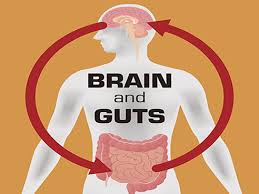
The idea that the earliest stages of Parkinson’s disease may occur in the gastrointestinal tract has been gaining movement (pardon the pun). A growing body of evidence supports this hypothesis, but the question of how changes in the intestines drive neurodegeneration in the brain remains an active area of investigation. Some studies propose that aggregates of alpha synuclein move from the intestines to the brain through the vagus nerve. Others suggest that molecules such as bacterial breakdown products stimulate activity along this channel, or that that the gut influences the brain through other mechanisms, such as inflammation. Together, however, these findings add to the growing consensus that even if Parkinson’s is very much driven by brain abnormalities, it doesn’t mean that the process starts in the brain.
The Gut-Brain Highway
The vagus nerve, the bundle of fibres that originates in the brain stem and innervates major organs, including the gut, may be the primary route through which pathological triggers of Parkinson’s travel from the gastrointestinal tract to the brain. Recent examinations of patients whose vagus nerves were severed show that they have a lower risk of developing Parkinson’s. Researchers have also demonstrated that alpha-synuclein fibres, injected into the gastrointestinal tracts of rodents, can travel through the vagus into the brain.
 If alpha-synuclein does travel from the intestines to the brain, the question still arises: Why does the protein accumulate in the gut in the first place? One possibility is that alpha-synuclein produced in the gastrointestinal nervous system helps fight off pathogens. Last year, Michael Zasloff, a professor at Georgetown University, and his colleagues reported that the protein appeared in the guts of otherwise healthy children after norovirus infections, and that, at least in a lab dish, alpha-synuclein could attract and activate immune cells.
Microbes themselves are another potential trigger for promoting the build-up of intestinal alpha-synuclein. Researchers have found that, in mice, bacterial proteins could trigger the aggregation of the alpha-synuclein in the gut and the brain. Some proteins made by bacteria may form small, tough fibres, whose shape could cause nearby proteins to misfold and aggregate in a manner similar to the prions responsible for mad cow disease.
The microbiome, the totality of microorganisms in the human body, has spurred intense interest among Parkinson’s researchers. A number of reports have noted that individuals with the disease harbour a unique composition of gut microbes, and scientists have also found that transplanting fecal (poo!) microbes from patients into rodents predisposed to develop Parkinson’s can worsen motor symptoms of the disease and increase alpha-synuclein aggregation in the brain.
But rather than bacterial proteins triggering misfolding, Sarkis Mazmanian, a Caltech microbiologist, believes that these microbes could be acting through the metabolites they produce, such as short-chain fatty acids. Mouse experiments from his lab have shown that these molecules appear to activate microglia, the immune cells of the brain. The metabolites, Mazmanian adds, may send a signal through the vagus nerve or bypass it completely through another pathway such as the bloodstream. Because studies find that vagus nerve removal does not completely eliminate the risk of Parkinson’s, other brain-gut routes may also be involved.
A Role for Inflammation?
Yet another idea holds that that intestinal inflammation, possibly from gut microbes, could give rise to Parkinson’s disease. The latest evidence supporting this idea comes from a large study, in which Inga Peter, a genetic epidemiologist at the Icahn School of Medicine at Mount Sinai, and her colleagues scanned through two large U.S. medical databases to investigate the overlap between inflammatory bowel diseases and Parkinson’s.
 Their analysis compared 144,018 individuals with Crohn’s or ulcerative colitis and 720,090 healthy controls. It revealed that the prevalence of Parkinson’s was 28 percent higher in individuals with the inflammatory bowel diseases than in those in the control group, supporting earlier findings from the same researchers that the two disorders share genetic links. In addition, the research team discovered that in people who received drugs used to reduce inflammation—tumour necrosis factor (TNF) inhibitors—the incidence of the neurodegenerative disease dropped 78 percent.
This study further validates the theory that gut inflammation could drive Parkinson’s development. The anti-TNF finding in particular, suggests that the overlap between the two diseases might be primarily mediated by inflammation.
Intestinal inflammation might give rise to Parkinson’s in several ways. One possibility is that a chronically inflamed gut might elevate alpha-synuclein levels locally—as Zasloff’s investigation in children suggests—or else it may give rise to inflammation throughout the body, which in itself could increase the permeability of the gut and blood-brain barriers. Or else it could increase circulating cytokines, molecules that that can promote inflammation. In addition, changes in the microbiome could also be influencing gut inflammation.
There are probably multiple pathways that lead the gut to the brain. For now, Inga Peter and her team are focused on determining whether the protective effect of anti-TNF compounds is due to the lowering of inflammation throughout the body, which could result from other conditions, or whether they only benefit individuals with bowel disorders. Peter plans to investigate the prevalence of Parkinson’s in other patients who take these drugs, such as those with psoriasis or rheumatoid arthritis.
 Because not all Parkinson’s patients will have inflammatory bowel disorders, findings from the investigations into the co-occurrence of the two conditions might not generalise to everyone with the neurodegenerative disease. Still, these studies and many others that have emerged in recent years support the idea that the gut is involved in Parkinson’s is correct. If this turns out to be true in the long run then it may allow researchers to devise treatments that target the gut instead of the brain.
Already, some researchers have started to test such treatments. In 2015, Zasloff and his colleagues launched a company, Enterin, that is currently testing a compound that slows alpha-synuclein aggregation in the gut. Although the treatment is intended to reduce non-motor symptoms of Parkinson’s, such as constipation, the researchers hope that by targeting early gut pathology, they will be able to restore—or prevent—the disease’s effects on the central nervous system.
While many lines of evidence support the gut origins of Parkinson’s, the question of how  early the gastrointestinal changes occur remains. In addition, other scientists have suggested that it is still possible that the disease begins elsewhere in the body. In fact, Braak and his colleagues also found Lewy bodies in the olfactory bulb, which led them to propose the nose as another potential place of initiation (Interestingly, from a natural medicine perspective, we’re taught that loss of the sense of smell is a very early warning sign for Parkinson’s). It could turn out to be that there are multiple sites of origin for Parkinson’s disease. For some people, it might be the gut, for others it might be the olfactory system—or it might just be something that occurs in the brain.
Researching all these new findings got me excited because if inflammation is a trigger or cause for diseases like Parkinson’s then an anti-inflammatory diet could be a clue that the researchers haven’t even clued into yet. This is a self-help action that people can easily do for themselves: lots of green vegetables, less gluten/dairy/alcohol, a good night’s sleep and stress reduction (for example, meditation). All that helps you poop better too! I think that Parkinson’s patients with their arsenal of drugs, deep brain stimulation implants and decreasingly quality of life would sign up for that in droves. What do you think?